
THE WORLDS FINEST SHIP, ALSO KNOWN AS HOME
Safety, fire fighting, lifesaving
With its full double hull, heavy construction to ice class and massive internal subdivision and very limited internal access below the waterline Raffles is inherently safe, especially when compared to any other vessel afloat.
In addition it carries lifesaving, fire prevention / detection and safety equipment that is in some cases 500% more than required by international and Isle of Man law.

The four Schat – Harding 150 survivors enclosed lifeboats and davits are located port and starboard on two boat decks at the main deck.
The emphasis on safety reflects that Raffles will operate for long periods in remote areas of the world where external assistance coastguard, fire brigade or ambulance is non existent, or a very long time arriving.
For lifesaving / evacuation of Raffles about 400 occupants it has three + one separate systems:
- 4 x 150 passenger enclosed lifeboats
+1 x stern slide launched tug / lifeboat RIB type with 1,500 nautical mile (towing) range - 1 x 436 survivors marine evacuation system with 4 fully reversible liferafts
- 8 x 100 survivor MARIN – ARK fully reversible liferafts
- 4 x special survival stores stainless capsules
- 200% lifebelts (inflatable and solid type)
+ rings + quick launch spar buoys

RFD 430 survivors, 4 fully reversible liferafts, MES
The unique tug – lifeboat, launched over the stern, is specially designed and outfitted to tow the four main boats + rafts out of a sinking in Antarctica to the nearest continent, while also unique to Raffles the four float free survival capsules will allow 400 survivors to live ashore in Antarctica for 2 weeks.
In addition most of Raffles about 20 recreational boats have a dual purpose, and with larger units equipped to act as rescue or lifeboats in an emergency, they almost triple the officially required lifesaving capacity. The 15m expedition / dive boats, able to carry 100 in an emergency, are fully equipped with radar, satnav / coms and can also be used as tugs.
The main ship wide fire detection / suppression system is based around a Marioff hi-fog – water mist system that protects 95% of occupied spaces plus others such as main machinery. The pump / accumulator units at the heart of hi-fog system are nearly six times in number the recommended level and provide coverage about equal to that installed on the QM2!
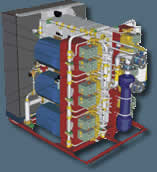 |
There are at least nine of these hi-fog pump / accumulator units, with one located on each apartment deck. |
The critical machinery spaces are protected by the same hi-fog system, but in the two main machinery spaces there are three additional / overlapping systems including foam, inert gas and rapid drenching using water from the swimming pool. Some WT spaces such as the HFO fuel treatment and crew’s galley, not normally occupied or that can be shut down / evacuated quickly are protected by high expansion full foam flooding.
Apart from its very rapid suppression of fire an advantage of hi-fog is that it does not destroy the contents of a space and also does not cause flooding that can lead to instability.
On a personal level in each apartment, in addition to being fitted with combined smoke / heat detectors there are additional CO2 detectors in bedrooms and each permanent occupant is provided with a personal 15 minute air breathing device , VHF radio, chargeable torch and whistle. All the crew and crew quarters have similar equipments / arrangements. Portable extinguishers, well in excess of rules are provided at about 120 fire (hose reel) points throughout Raffles and in each apartment / crew quarters.
 |
Dräger 15 minutes fire escape |
Large wheeled high expansion foam generators are located at the aft open deck and in the marina for fighting fires on vehicle / boats.
Each apartment is a totally enclosed A60 fire zone meaning that a fire can start and is contained without any damage to surrounding apartments and structure for at least 60 minutes.
A unique feature is a CCTV monitoring the electric cooking surfaces in the kitchen activated by either a heat / infra red or smoke or rate of temperature rise sensor. The CCTV is switched on automatically and monitored in the control room while local fire extinguishers are automatically activated and the cooking surface is retracted down into a fire proof cabinet.
Pneumatic or electric operated sliding action A60 fire doors are fully recessed into the core at typically 20 meters intervals along passage ways in the superstructure. The number installed is in excess of SOLAS and designed to isolate any fire quickly. Doors can be remote or locally manually operated. Doors air supply is also from 24 volt system so fail safe.
Similar doors to SOLAS are provided at the main deck and in the hull. Hinged closing A60 doors may be used in some locations where they cannot be recessed.
Similar doors may be used in the crew galley and spaces such as the hospital laboratory.
Throughout the vessel a conventional pressurised fire main system with about 120 hose reel stations means that no occupied space is more than 30m/100ft from a fire point
Backing up these systems is a CCTV network including thermal cameras that means the control room can visually detect most problems and a ship wide wi-fi, VHF and back up sound powered phone, communications system that means crew are always on call to respond quickly.
A unique feature on Raffles is that at least one maid / concierge is always on duty 24-7 at each apartment level and is trained to act as a first responder to fire and medical emergencies. Equipped with a mobile fire engine / emergency wagon garaged on each accommodation level, including the main deck and crew quarters, they can reach any part of the accommodation in a minute.
The “fire engine” has special equipment for fighting fires, thermal location, saving lives, and first aid. Other fire engines can be moved between decks by the lifts as needed and Raffles crew will include a fire fighting team trained by the UK Royal Navy.
Raffles has another safety feature that is totally unique in any passenger vessel. In memory of that vessel this is named the “Derbyshire” system and is based around a 24 volt pump / level switch unit installed in all WT compartments below / at the water line plus other such as the fore peak. These units are so sensitive that they sound an alarm when only 1cm of water enters a compartment and if more they automatically start pumping it out. Tied in to a dedicated PC in the control room and bridge they provide an early warning system of any water entering the hull, when the one of the ships three (3) separate main evacuation pumping systems can be activated as back up.